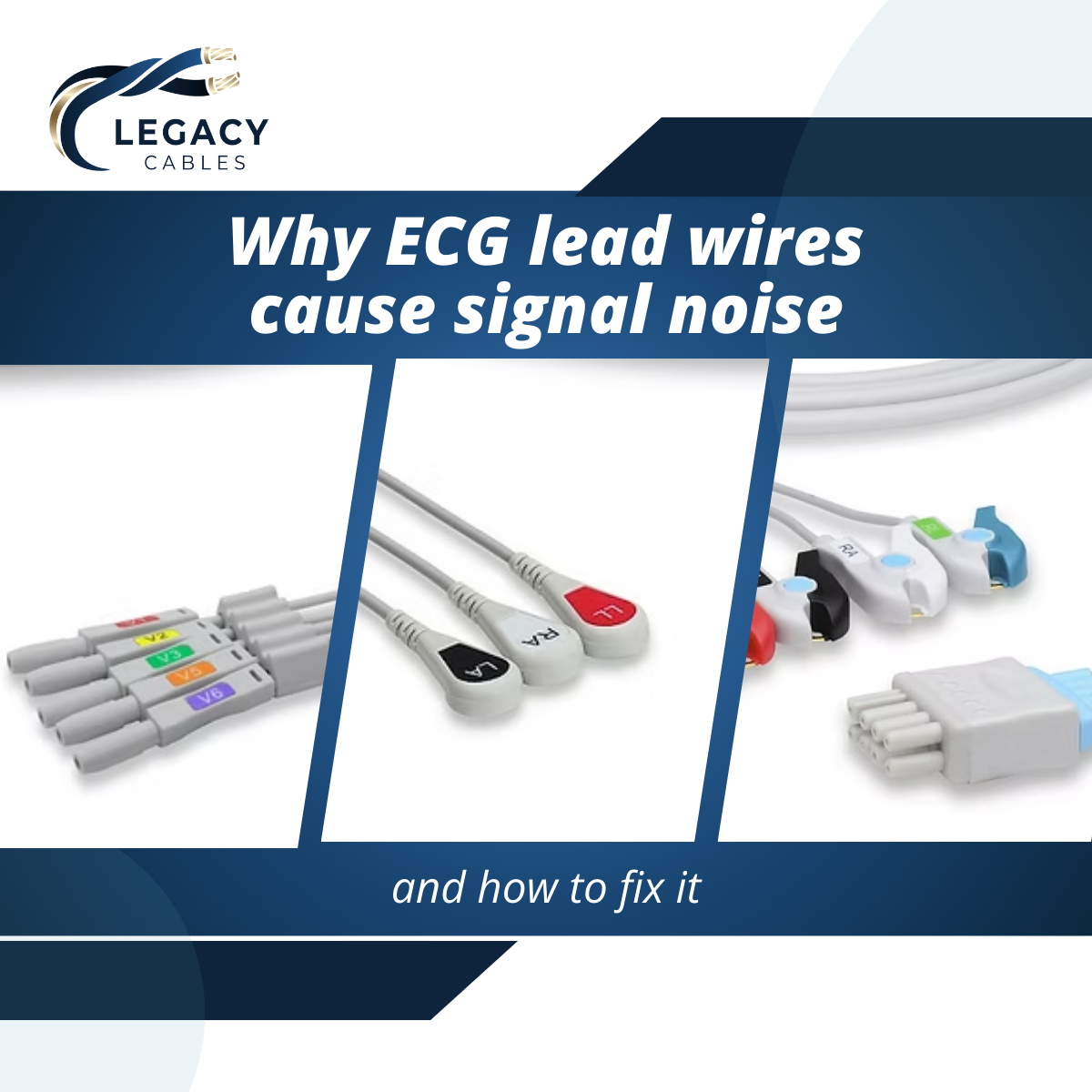
Why ECG lead wire noise is one of the most common monitoring issues
ECG signal noise is a frequent problem in patient monitoring environments. Baseline wander, random spikes, or unstable waveforms often appear suddenly and are commonly misattributed to monitor failure. In reality, the ECG lead wire is the most frequent root cause.
Because lead wires are flexed, cleaned, and reconnected multiple times per day, they are among the highest-wear components in any monitoring system.
Common causes of ECG lead wire noise
ECG noise typically originates from one or more of the following:
- Internal conductor breakage caused by repeated bending
- Degraded shielding, allowing electromagnetic interference
- Loose or worn connectors at the monitor or trunk cable interface
- Fluid intrusion from aggressive cleaning or disinfection
- Proximity to EMI sources such as power cords or infusion pumps
Even when no external damage is visible, internal wire fatigue can disrupt signal integrity.
How to fix ECG signal noise quickly
A fast way to isolate the issue:
- Swap the lead wire with a known-good cable
- If the noise disappears immediately, the lead wire is confirmed as the source
- If not, inspect the trunk cable and monitor input

In most cases, replacing the lead wire resolves ECG noise faster than recalibrating or servicing the monitor.
Repair vs Replacement: What actually works
While temporary fixes may reduce noise briefly, repairing ECG lead wires is rarely reliable in clinical environments. Once shielding or internal conductors are compromised, performance degradation usually returns.
Hospital-grade replacement ECG lead wires are designed with:
- Reinforced internal conductors
- Improved shielding against EMI
- Secure strain relief at high-stress points
Reduce ECG noise at the source. Explore our hospital-grade ECG lead wires and replacement cables, engineered for reliable signal transmission and long-term clinical use.